




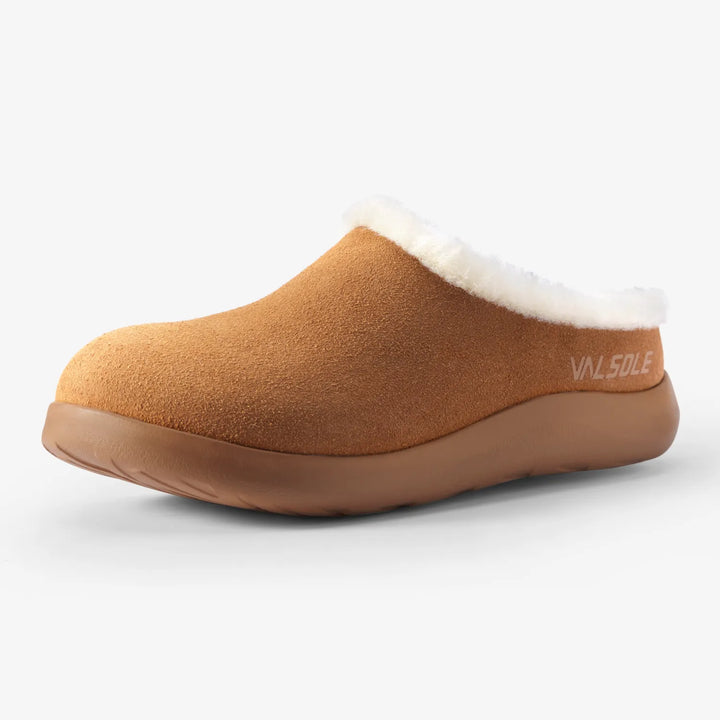
Hearth Clog
The Hearth Clog provides structured everyday stability and thermal comfort for users 220 lbs+,...
$59.99$89.99
View product


Recovery slippers should reduce residual stress, not just feel plush for a few minutes. For most users with heel or arch sensitivity, a supportive platform with controlled cushioning outperforms ultra-soft foam that compresses quickly and allows instability. The goal is to unload tissues while preserving alignment during low-load movement at home.
In practice, the best recovery setup blends cushioning and guidance. Extreme softness without structure is often a short-term comfort trap.
Use this table to decide which variable to prioritize based on your symptom pattern.
| Priority | Main benefit | Best for | Risk when overdone |
|---|---|---|---|
| Arch support | Alignment control and load distribution | Arch collapse, recurrent heel strain | Pressure ridges if profile is too aggressive |
| Cushioning | Impact comfort and pressure diffusion | Hard-floor walking and soreness | Instability if material bottoms out |
| Balanced blend | Stable comfort over time | Most daily recovery routines | Requires correct fit and platform geometry |
If symptoms are heel-dominant after long standing, prioritize controlled cushioning plus reliable heel stabilization. If symptoms are arch-dominant with late-day collapse, prioritize support retention with moderate cushioning. If both are present, use a balanced platform and validate over one week before moving to stronger profiles.
Choose based on where pain appears at the end of the day, not only where it starts in the morning.
Confirm heel stability, midfoot contact, and forefoot space after 30-60 minutes of use. If the foot slides or toes grip to stabilize, the platform is likely too unstable despite soft comfort. For recovery footwear, stable contact and controlled motion are better predictors of symptom improvement than softness alone.
Recovery footwear should reduce correction effort, not force your foot to work harder to stay balanced.
Track evening soreness, next-morning stiffness, and indoor walking comfort. Keep the model that improves all three together. If evening comfort improves but morning stiffness does not, you likely need more structural guidance. If stiffness improves but evening fatigue rises, cushioning may be insufficient for your floor conditions.
The winning recovery slipper is the one that improves next-day readiness, not just same-minute softness.
For next steps, calibrate structure in the Arch support guide, compare real-world recovery fit with Hearth Clog, and verify sizing and volume constraints in the Size guide.
Shop the products most relevant to the support path discussed in this article.

Keep reading with symptom-based guides and compare support options for your pain profile.


Loading size guide…


